Trading is often portrayed as a game of predictions — finding the next big move, catching the perfect breakout, or timing the exact reversal. In reality, professional trading is not about prediction at all. It is about risk management.
Markets are uncertain by nature. Even the best strategy fails sometimes. What separates consistent traders from struggling ones is not how often they are right, but how well they control losses when they are wrong.
This article breaks down risk management from a technical, professional perspective. Whether you trade stocks, options, forex, or indices, mastering these principles is non-negotiable if you want to survive long term.
Understanding Risk in Trading (Beyond the Basics)
Risk in trading is not just about losing money. It is about exposure.
Every trade exposes your capital to:
- Market volatility
- Execution risk
- Emotional decision-making
- Structural market uncertainty
Professional traders define risk before they place a trade, not after price moves against them.
Risk is quantifiable. Hope is not.
Why Most Traders Fail Without Realizing It
Retail traders often believe they fail because:
- Their strategy is weak
- Indicators don’t work
- The market is manipulated
In reality, most failures come from:
- Oversized positions
- No predefined stop loss
- Emotional averaging
- Inconsistent execution
A trader with an average strategy and strong risk management will outperform a trader with a great strategy and poor risk control.
Position Sizing: The Foundation of Risk Management
Position sizing answers one question:
How much should I trade on this setup?
Most beginners decide position size based on:
- Available margin
- Confidence level
- Recent wins or losses
Professionals decide position size based on:
- Account size
- Risk per trade
- Stop-loss distance
The Fixed Percentage Risk Model
A widely used professional approach is risking a fixed percentage of capital per trade.
Example:
- Trading capital: ₹5,00,000
- Risk per trade: 1%
- Maximum loss allowed: ₹5,000
If your stop loss is hit, your loss is predefined and controlled.
This approach ensures:
- No single trade can damage your account
- Emotional pressure stays low
- Longevity in the market
Stop Loss: The Line Between Trading and Gambling
A stop loss is not a failure point.
It is an invalidation point.
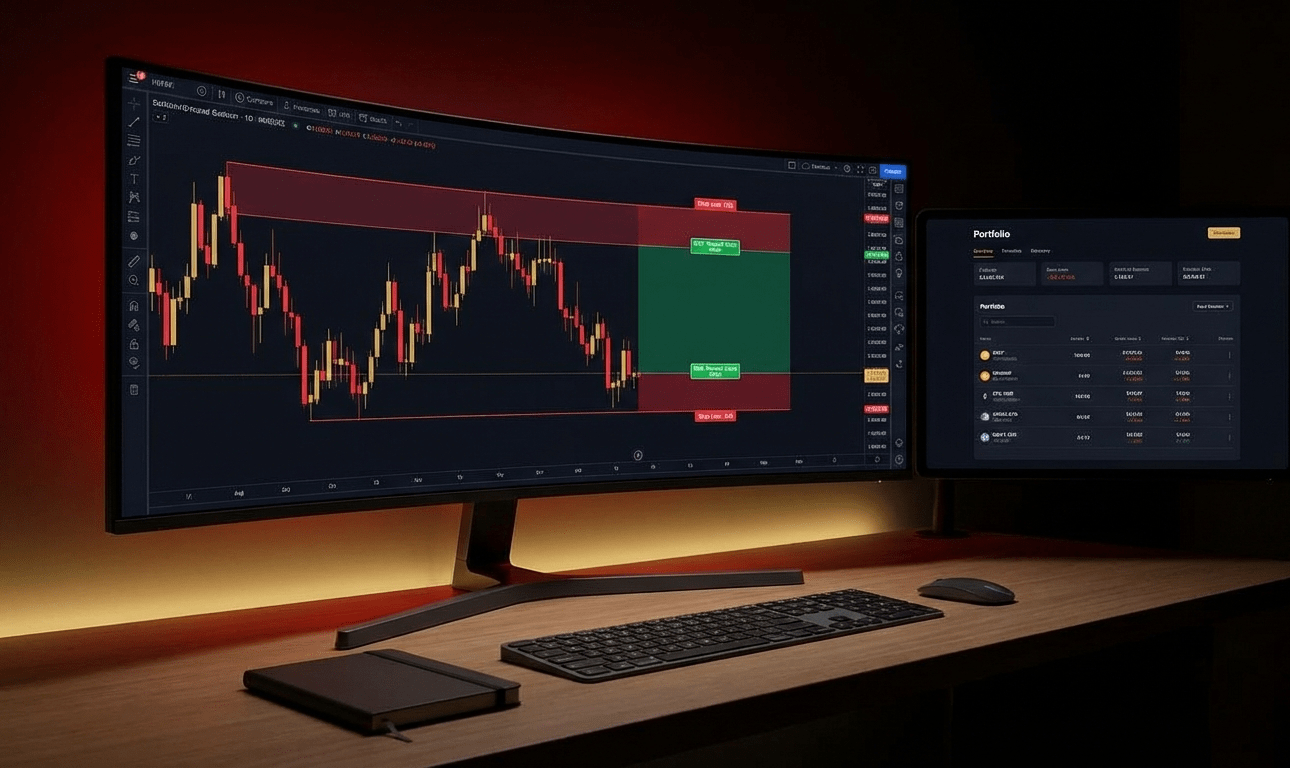
Professionals place stop losses based on market structure, not emotions.
Technically Sound Stop Loss Placement
Stop losses are usually placed:
- Beyond demand or supply zones
- Below/above recent swing highs or lows
- Beyond key liquidity levels
A stop loss should answer:
At what price is my trade idea proven wrong?
If you cannot answer that, you are guessing — not trading.
Risk–Reward Ratio: Why Accuracy Alone Doesn’t Matter
Many traders obsess over win rate. Professionals focus on risk–reward asymmetry.
A trader can be profitable with:
- 40% win rate
- 1:3 risk–reward
That means:
- Losing trades are small
- Winning trades are meaningful
Example:
- Risk per trade: ₹2,000
- Target: ₹6,000
You can be wrong more often than right and still grow your account.
This is why professional trading systems prioritize:
- Asymmetric payoffs
- Selective entries
- Patience
Drawdown Management: The Silent Account Killer
Drawdown is the percentage decline from your account’s peak.
Most traders ignore drawdown until it becomes dangerous.
Why Drawdowns Matter Technically
A 10% drawdown requires an 11% recovery
A 30% drawdown requires a 43% recovery
A 50% drawdown requires a 100% recovery
The deeper the drawdown, the harder the recovery.
Professionals cap drawdowns by:
- Reducing position size during losing streaks
- Taking breaks after consecutive losses
- Avoiding emotional revenge trading
Emotional Risk vs Market Risk
Not all risk comes from price movement.
Emotional risk includes:
- Fear of missing out
- Overconfidence after wins
- Revenge trading after losses
- Breaking rules under pressure
This is why professional traders use:
- Written trading plans
- Predefined rules
- Journals to track behavior
Systems reduce emotional interference. Discipline preserves capital.
Risk Management in Different Market Segments
Equity Trading
- Lower leverage
- Slower moves
- Risk comes from gaps and news
Intraday Trading
- Faster execution
- Tight stop losses
- Higher emotional pressure
Options Trading
- Hidden risk through volatility
- Time decay (Theta)
- Complex risk profiles
Forex Trading
- High leverage
- News-driven volatility
- Overnight exposure
Each market requires adjusted risk rules, but the principles remain the same.
The Role of Journaling in Risk Control
Professional traders track:
- Entry reason
- Stop loss logic
- Position size
- Emotional state
- Outcome
Journaling reveals:
- Repeated mistakes
- Overtrading patterns
- Risk violations
Without data, improvement is impossible.
Why Structured Training Accelerates Risk Mastery
Risk management is not intuitive.
It must be trained and practiced under guidance.
This is why traders who learn through:
- Random videos
- Telegram tips
- Trial-and-error
Take much longer to develop consistency.
Learning risk management through a structured environment, such as a professional stock market institute in Jaipur, helps traders:
- Understand real market behavior
- Apply risk rules in live markets
- Develop discipline early
Risk Management Is a Skill, Not a Rulebook
Many traders know risk rules intellectually but fail to apply them emotionally.
Professional trading education focuses on:
- Behavior under pressure
- Rule-following consistency
- Long-term capital protection
Risk management is not about avoiding losses. It is about controlling them.
Final Thoughts: Survival Before Profits
The market rewards longevity.
If you protect your capital:
- You stay in the game
- You gain experience
- You compound skill over time
If you ignore risk:
- One emotional decision can erase months of progress
Professional traders think in terms of process, not outcomes.
Master risk first. Profits follow as a byproduct.