Last week, a student walked into our Jaipur classroom after losing ₹45,000 in three days. Not because he didn’t know technical analysis. Not because he picked the wrong stocks. He lost because on Day 1, he saw Nifty rallying and thought, “I’ll miss out if I don’t get in NOW.” On Day 3, when his positions were bleeding, he held on thinking, “It has to bounce back. It always does.”
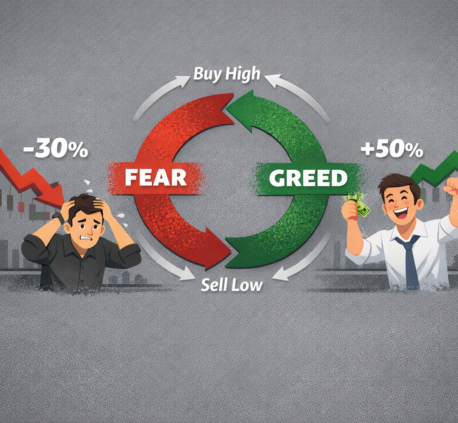
Classic fear and greed cycle. And he’s not alone.
According to SEBI data, 91% of individual F&O traders lost money in FY25. The total damage? ₹1.06 lakh crore. These aren’t people who don’t understand candlestick patterns or support levels. They’re people who don’t understand their own brains.
Today, we’re going to talk about why fear and greed destroy more trading accounts than bad strategies ever could. And more importantly, how you can recognize these emotions before they ruin you.
What Is the Fear and Greed Cycle?
The stock market runs on two emotions: fear and greed. Not logic. Not fundamentals. Emotions.
When markets are climbing and everyone’s making money, greed takes over. You see stocks doubling in weeks. Your neighbor just booked ₹50,000 profit on some stock you’d never heard of. Your brain screams: “You’re missing out. Get in before it’s too late!”
So you buy. Usually near the top.
Then the market turns. Your ₹10,000 position is now worth ₹7,000. Fear kicks in. “What if it goes to zero? What if I lose everything?” You panic sell at the worst possible time. The stock recovers two days later, but you’re already out.
This is the fear and greed cycle. And it’s been bankrupting traders since markets existed.
Warren Buffett famously said: “Be fearful when others are greedy, and greedy when others are fearful.” Sounds simple. It’s not. Because when everyone around you is making money and you’re sitting on cash, your brain doesn’t care about Warren Buffett’s wisdom. It cares about not being left behind.
The Fear and Greed Index: A Tool You Should Know
There’s actually a way to measure market-wide fear and greed. It’s called the Fear and Greed Index, originally created by CNN Money for the US stock market, and similar versions exist for crypto markets.
The index runs from 0 to 100:
- 0-25: Extreme Fear
- 25-49: Fear
- 50-74: Greed
- 75-100: Extreme Greed
It measures things like market volatility, trading volumes, put/call ratios, and how many stocks are hitting new highs versus new lows. When everyone’s panicking and selling, the index drops toward 0. When everyone’s euphoric and buying everything, it shoots toward 100.
Here’s the interesting part: extreme readings often signal turning points. When the index hits extreme fear, markets are often oversold and ready to bounce. When it hits extreme greed, a correction is usually around the corner.
But knowing this intellectually and actually using it when your money is on the line? Two completely different things.
How Fear Shows Up in Your Trading
Let’s get specific. Here’s what fear looks like in real trading situations:
1. Panic Selling at the Bottom
The market drops 3% in one day. Your portfolio is down ₹15,000. You convince yourself: “This is just the beginning. It’s going to crash harder. I need to get out NOW before it’s too late.”
You sell. The next week, markets recover. You locked in your losses at the exact worst time.
During COVID in March 2020, Nifty fell from 12,000 to 7,500. Traders who panic-sold at 7,500 watched helplessly as the market rallied to 18,000 over the next 18 months. Those who stayed calm made generational wealth. The panicked ones made permanent losses.
2. Refusing to Take Small Losses
You bought a stock at ₹500. It’s now at ₹470. You tell yourself: “It’s only a temporary dip. I’ll wait for it to come back to ₹500, then I’ll exit.”
It goes to ₹450. Then ₹420. You’re still holding because you refuse to accept the loss. This is called loss aversion—the fear of realizing you were wrong is stronger than the logic of cutting losses early.
Before you know it, you’re down 30% on a position that should have been a 6% stop loss.
3. Sitting on Cash During Recovery
Markets have been beaten down. There are legitimate bargains everywhere. But you’re scared. “What if it falls more? What if this is a dead cat bounce? What if I’m wrong again?”
So you sit on the sidelines while the best buying opportunities of the year pass you by. This is fear disguised as prudence.
How Greed Shows Up in Your Trading
Greed is sneakier than fear. It doesn’t feel like greed. It feels like confidence, ambition, or “seeing an opportunity.”
1. FOMO (Fear of Missing Out)
You see your friends posting screenshots of their profits. Some stock just went up 20% in two days. You don’t know anything about the company, but you buy anyway because “everyone’s making money except me.”
This is greed wearing a FOMO mask. You’re not investing based on research or strategy. You’re buying based on envy and the desperate need to not be left out.
FOMO trades almost always lose money. Why? Because by the time something’s popular enough for you to hear about it, the easy money has already been made.
2. Overleveraging in F&O
You made ₹5,000 on a small options trade last week. Now you think: “If I trade 10x larger, I’ll make ₹50,000 next week.”
So you deploy your entire capital in a single high-risk position. You’re not thinking about what happens if you’re wrong. You’re only thinking about the massive gain when you’re right.
This is how traders blow up accounts. One bad trade with too much leverage, and three months of gains evaporate in three hours.
3. Holding Winners Too Long
Your stock went from ₹200 to ₹300. You had a plan to exit at ₹300, but now you’re thinking: “Why stop here? It could go to ₹400!”
It reaches ₹320. Then ₹290. Then ₹250. You’re still holding because you got greedy. What was a 50% profit is now a 25% profit. Sometimes it turns into a loss.
Greed makes you abandon your plan right when you should be sticking to it.
The Real Damage: Revenge Trading
Here’s where fear and greed combine to create the most destructive trading behavior: revenge trading.
You lost ₹10,000 on a trade. You’re frustrated. Angry. You feel like the market “owes you” that money back. So you immediately jump into another trade—not based on analysis, but based on the desperate need to recover your loss.
This trade is bigger than your usual size because you need to make ₹10,000 quickly. Your risk management goes out the window. You’re not thinking clearly. You’re trading emotionally.
You lose another ₹8,000.
Now you’re down ₹18,000 and even more emotional. The spiral continues. This is how traders turn a ₹10,000 bad day into a ₹50,000 catastrophic week.
I’ve seen it dozens of times. Smart people, good strategies, complete meltdown. Not because they didn’t understand markets. Because they didn’t understand their emotions.
Breaking the Cycle: What Actually Works
Alright, enough doom and gloom. Let’s talk solutions. How do you actually escape the fear and greed cycle?
1. Have a Trading Plan (And Actually Follow It)
This sounds basic, but 90% of retail traders don’t have one. A real trading plan includes:
- Entry criteria (Why am I entering this trade?)
- Exit criteria (When do I take profit? When do I cut losses?)
- Position size (How much capital am I risking?)
- Risk-reward ratio (Am I risking ₹1,000 to make ₹3,000?)
Write it down. Follow it. When fear or greed shows up, your plan is what saves you.
I tell every student at Vaishvik Traders: “Your plan might be wrong. But trading without a plan is guaranteed to be wrong.”
2. Use Stop Losses—No Exceptions
Stop losses protect you from yourself. They force you to cut losing trades before emotions take over.
Set your stop loss when you enter the trade, not after it starts moving against you. And once it’s set, don’t move it unless the market gives you a logical reason (like new support forming).
Moving stop losses to “give the trade more room” is greed. Removing stop losses because “you know it’ll bounce back” is hope. Both will destroy you.
3. Keep a Trading Journal
Track every trade. Not just wins and losses, but how you felt.
- “Was I emotional when I entered this trade?”
- “Did I follow my plan?”
- “Did FOMO influence this decision?”
Over time, patterns emerge. You’ll notice you always chase momentum on Fridays. Or you panic sell on big gap-down days. Or you overtrade after a win.
Once you see the patterns, you can fix them. But you have to track them first.
4. Take Breaks After Big Wins or Losses
Here’s a rule I force on students: if you have a big win or a big loss, take the rest of the day off.
After a big win, you’re overconfident. Your brain thinks you’re invincible. You’ll make reckless trades.
After a big loss, you’re emotional. Your brain wants revenge. You’ll make desperate trades.
Both lead to bigger losses. Step away. Clear your head. Come back tomorrow with a fresh mindset.
5. Reduce Position Sizes Until You’re Comfortable
If you’re constantly stressed about your trades, you’re trading too large. Fear and greed amplify when real money is on the line.
Cut your position sizes in half. Trade smaller. Get comfortable with the process. Once you can trade 100 shares without emotions taking over, then scale up to 200.
But if you’re checking your phone every 10 minutes and feeling sick when the market moves against you? You’re overexposed.
6. Learn to Recognize Your Emotional Triggers
Everyone has them. For some people, it’s seeing big green candles (triggers FOMO). For others, it’s a losing streak (triggers revenge trading).
Pay attention to what situations make you emotional. Then create rules to protect yourself in those situations.
For example: “I don’t enter trades after 2 PM because I make impulsive decisions near closing.” Or: “I don’t trade on budget days because volatility makes me anxious.”
These aren’t signs of weakness. They’re signs of self-awareness.
The Uncomfortable Truth
Here’s what nobody wants to hear: you cannot completely eliminate fear and greed from trading. They’re hardwired into your brain. Millions of years of evolution made sure of that.
What you can do is recognize them. Name them. And have systems in place that prevent them from destroying your account.
The difference between a beginner and a professional trader isn’t that professionals don’t feel fear and greed. It’s that professionals have rules that override those emotions.
When fear says “sell everything,” their plan says “hold according to strategy.” When greed says “double down,” their risk management says “max 2% per trade.”
The plan wins. Not because they’re emotionless robots, but because they built systems that work even when emotions are screaming.
Why Most Traders Ignore This (Until It’s Too Late)
Trading psychology isn’t sexy. Learning candlestick patterns feels productive. Finding the next multibagger stock feels exciting. But examining your own emotional patterns? That’s uncomfortable work.
So most traders skip it. They think: “I’m different. I’m logical. I won’t make those mistakes.”
Then they lose ₹50,000 to revenge trading and realize they’re not different at all.
The traders who make it—the 9% who actually profit consistently—aren’t the ones with the best technical analysis. They’re the ones who understand themselves. They know their triggers. They have systems. They trade their plan, not their emotions.
What We Teach at Vaishvik Traders
Technical analysis is important. Fundamental analysis matters. Risk management is critical.
But none of it works if you can’t control your own mind.
That’s why our courses in Jaipur don’t just focus on charts and indicators. We teach you to recognize when fear is making you hold losing trades too long. We show you what greed looks like when you’re about to overtrade. We build systems that protect you from yourself.
Because the market doesn’t care how much you know. It cares whether you can execute your knowledge without letting emotions hijack your decisions.
The Bottom Line
The fear and greed cycle destroys more trading accounts than market crashes ever will. It’s not about being smarter. It’s about being more disciplined.
Warren Buffett’s advice to “be fearful when others are greedy and greedy when others are fearful” isn’t a trading strategy. It’s a psychological framework. It forces you to think independently instead of following the crowd.
When everyone’s euphoric and buying, that’s your signal to be cautious. When everyone’s panicking and selling, that’s your signal to look for opportunities.
But doing this requires you to sit with discomfort. To be patient when everyone else is making money. To buy when everyone else is terrified. To sell when everyone thinks you’re crazy for taking profits.
The good news? Once you understand the cycle, you start seeing it everywhere. In news headlines. In market chatter. In your own trading decisions. And once you see it, you can step outside it.
The market will always oscillate between fear and greed. That’s not changing. The question is: will you oscillate with it, or will you use it to your advantage?
Want to build trading discipline and learn how to recognize emotional patterns before they cost you money? That’s exactly what we do at Vaishvik Traders in Jaipur. We don’t just teach technical analysis—we teach you how to trade when fear and greed are screaming in your ear. Because that’s when trading actually matters.
The charts are easy. Your brain is the hard part. Let’s fix both.https://vaishviktrader.com/