Here’s a conversation that happens in our Jaipur classroom almost every week.
A new student walks in, already excited. They’ve watched a few YouTube videos, seen a few screenshots of someone turning ₹10,000 into ₹1,00,000 in two days, and they’ve made up their mind options trading is the shortcut they’ve been looking for.
Then the very next student walks in and says they’ve heard the opposite. That buying options is a “mug’s game.” That the smart money sells options, collects premium, and sleeps peacefully every night.
Two students. Two completely opposite beliefs. Both picked up from the internet.
Both, in their current state, are wrong.
Not because the information they found was false parts of it are true but because they’re applying general advice to a stage of learning where general advice does more harm than good.
So let’s talk about this properly. No hype, no false promises. Just what option buying and option selling actually are, how they behave in the real Indian market, and most importantly when a beginner should make the switch from one to the other.
What Is Option Buying? (And Why It Feels So Exciting)
When you buy an option whether it’s a Call or a Put you’re paying a premium upfront for the right to buy or sell an underlying asset (like Nifty 50 or Bank Nifty) at a specific price before a specific date.
You don’t have to exercise that right. But you pay for it regardless.
Example: You buy a Bank Nifty Call option at a premium of ₹200 per unit. One lot is 15 units. So your total cost is ₹3,000. If Bank Nifty moves sharply in your direction over the next two days, that ₹200 premium could become ₹600, ₹800, even ₹1,500. Your ₹3,000 becomes ₹22,500.
That’s a 650% return in two days. This is why YouTube thumbnails exist.
But here’s what those thumbnails don’t show: if Bank Nifty doesn’t move, or moves slowly, or moves but not enough that ₹200 premium quietly melts to zero. Your ₹3,000 is gone. Not partially gone. Gone.
This happens far more often than the 650% return does.
What Is Option Selling? (And Why It Feels So Safe)
When you sell an option, you flip to the other side of the trade. Instead of paying premium, you collect it. You’re now the one giving someone else that right and your job is to make sure they never need to use it.
Example: You sell that same Bank Nifty Call at ₹200. You collect ₹3,000 upfront. If Bank Nifty stays flat, moves slowly, or moves down, that option expires worthless. The buyer loses. You keep the ₹3,000.
This sounds brilliant. And often, it is because statistically, option sellers win more often than buyers do.
But here’s what the “sell options and sleep peacefully” crowd doesn’t tell you: when you’re wrong as a seller, you’re not wrong by a little. You can be wrong by a lot fast.
That ₹200 you collected? If Bank Nifty has a big gap-up day say, a surprise RBI announcement, or global market news overnight that same option could jump to ₹800, ₹1,200, even ₹2,000. You’ve collected ₹3,000 but now face a loss of ₹15,000 to ₹27,000 on a single lot.
Without proper risk management, option selling isn’t conservative. It’s a slow accumulation of small wins followed by one trade that wipes out months of effort.
The Core Difference Nobody Explains Clearly
Here’s the simplest way to understand the two sides:
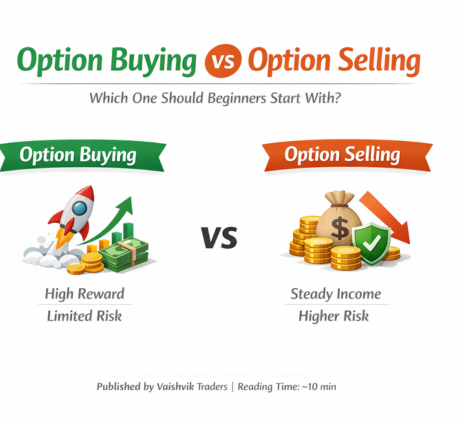
Option Buyers have limited risk (only the premium paid) and theoretically unlimited profit. But they fight against time, volatility, and probability. They need to be right about direction, timing, and magnitude all three to make money.
Option Sellers have limited profit (only the premium collected) and theoretically unlimited risk. But time works for them. Volatility decay works for them. The odds, statistically, are in their corner.
Neither is a guaranteed path to wealth. Both require a completely different mindset, skill set, and capital base to do well.
Why Most Beginners Start With Buying — And What Goes Wrong
Almost every beginner starts as an option buyer. And honestly? That’s not wrong.
The low capital requirement is genuinely appealing. You can buy an option with ₹3,000–₹10,000. To sell a naked option, you need ₹80,000–₹1.5 lakh in margin. The entry barrier alone pushes beginners toward buying.
But here’s what goes wrong almost every time:
They don’t account for Theta (time decay). Every day that passes, your option loses a small chunk of its value even if the market doesn’t move against you. In the last week before expiry, this decay accelerates dramatically. Beginners watch their premium shrink and don’t understand why. The market didn’t move much. But the clock did.
They get caught in IV Crush. Implied Volatility (IV) is essentially the market’s fear gauge baked into the option premium. Before big events Budget announcements, RBI policy, Election results IV spikes and premiums inflate. The moment that event passes, IV collapses. Beginners who buy options just before these events often watch their option fall in value even when the market moves in their direction. They were right about the move. But IV crushed them anyway.
They average down on losing positions. A stock doesn’t move for three days. The premium has halved. Instead of cutting losses, a beginner buys more “it has to move eventually.” Sometimes it does. More often, expiry arrives and the position goes to zero with twice the initial capital deployed.
They don’t have a stop loss. In option buying, your stop loss isn’t optional it’s survival. But beginners, hoping for a recovery, routinely let ₹3,000 become ₹300 before they exit.
Why Option Selling Isn’t the Easy Answer Either
After a few painful experiences as a buyer, many traders swing to the other extreme. “Option selling is the real business. The big institutions sell options. I’ll sell too.”
This line of thinking kills accounts just as effectively just more slowly, and then suddenly.
The margin requirement creates false security. Because you need significant capital to sell options, traders assume they’re more “serious” and “professional.” Capital requirements don’t make a strategy safe. They just make the losses bigger.
One bad trade undoes months of work. A seller might build ₹8,000–₹10,000 in premium income over a month of disciplined trading. Then a single black swan event a global crash, a sudden political development wipes out three to four months of gains in a single session. This isn’t a rare event. It has happened multiple times in Bank Nifty in the last three years.
Selling naked options without a hedge is speculation, not strategy. Most retail traders selling options are doing it without defined risk. No spread. No hedge. Just collecting premium and hoping for the best. That’s not a strategy. That’s gambling with extra steps.
The professional option sellers who actually make consistent money do it with structures spreads, iron condors, covered positions where the maximum loss is defined before the trade is placed.
So What Should a Beginner Actually Do?
Here’s our honest answer, based on teaching over 1,000 students at Vaishvik Traders:
Start with option buying. But not to make money. To understand how options actually behave.
This isn’t about the P&L. In the first 2–3 months, your real job is to experience and internalize what happens to a premium when time passes, when volatility shifts, and when the market moves (or doesn’t). You cannot fully understand the seller’s edge until you’ve felt the buyer’s pain.
Think of it like learning to drive. You start in an empty parking lot before you hit the highway. Not because the parking lot is more profitable, but because the consequences of mistakes are smaller.
The Honest Checklist: When Are You Ready to Switch to Option Selling?
Don’t make the switch based on how many months you’ve been trading. Make it based on whether you can honestly check every box below.
You understand why premiums change not just that they do. Can you explain Theta, Delta, Vega, and IV in plain language without looking them up? Not textbook definitions real explanations with examples from trades you’ve actually placed.
You’ve kept a trade journal for at least 50 trades. And you’ve read it. Do you know your win rate? Your average profit vs. average loss? Your biggest mistake pattern?
You can define your maximum loss before entering a trade. Not “I’ll exit if it goes wrong.” What’s the specific price level or percentage where you exit, no matter what?
You’ve experienced IV crush firsthand. You’ve watched an option lose value even when the market moved your way, and you understand exactly why it happened.
You have the capital to sell with a defined structure. Selling a naked option is not a beginner strategy. If you’re moving to selling, start with spreads a Bull Put Spread or a Bear Call Spread where both your maximum profit and maximum loss are fixed before you enter.
You can sit in a losing position calmly if your rules say to hold. And exit a losing position cleanly if your rules say to exit without averaging down, without hoping, without second-guessing.
If you can’t check even three or four of these, you’re not ready to sell options. That’s not a criticism. It’s just where you are right now. And knowing where you are is actually the most important thing.
The Transition Strategy: Don’t Jump. Step.
When you do decide you’re ready to explore option selling, don’t go from buyer to naked seller overnight.
Step 1: Start with Defined-Risk Spreads Your first experience with option selling should be a spread — either a Bull Put Spread (sell a Put, buy a cheaper Put below it) or a Bear Call Spread (sell a Call, buy a cheaper Call above it). Your loss is defined. Your margin requirement is lower. And you start learning what it feels like to have time working in your favour.
Step 2: Trade Only One Lot Capital doesn’t matter at this stage. Understanding does. Trade one lot. Keep a journal. Note your emotions before, during, and after the trade.
Step 3: Add complexity only after consistency Once you have 30–50 spread trades documented with a clear understanding of what worked and what didn’t, you can start exploring more complex structures Short Straddles, Short Strangles, Iron Condors. Not before.
A Real Example From Our Classroom
One of our students a salaried professional from Jaipur came to us having already lost ₹40,000 in options. He was buying weekly Bank Nifty options, hoping for big moves, and getting wiped out by theta decay every time the market didn’t cooperate.
He spent his first two months with us just understanding options not trading, or trading paper only. By month three, he started buying options with a clear stop loss and a defined reason for every trade. By month five, he moved to Bull Put Spreads on Nifty small lots, defined risk.
Today, he’s not a millionaire. But he’s consistently profitable, he understands exactly why each trade won or lost, and he’s never had a blow-up trade since he built that foundation.
That’s the journey. It’s not glamorous. But it’s the one that actually works.
The Bottom Line
Option buying and option selling are not enemies. They’re two sides of the same market and understanding both makes you a significantly better trader, regardless of which you eventually specialize in.
If you’re a beginner: Start with option buying. Trade small. Focus on understanding not on profits. Accept that the first few months are tuition fees, not income.
If you’ve been trading for a few months and understand the mechanics: Explore defined-risk option selling through spreads. Don’t rush to complex naked selling strategies.
If someone tells you one is always better than the other: They’re selling you a course, not the truth.
The market rewards people who take the time to genuinely learn their craft. There are no shortcuts but there’s also nothing stopping you from getting there, as long as you don’t blow up your account chasing the ones that don’t exist.
Ready to Build the Right Foundation?
At Vaishvik Traders, we teach options the way they should be taught from the buyer’s perspective first, with live market sessions where you see real premiums move in real time, and structured mentorship that walks you through the transition to selling when you’re actually ready.
We’ve trained 1,000+ students across Jaipur and online, and our courses cover everything from Options basics and F&O Mastery to Option Chain Analysis and Option Selling Strategies — in the right sequence, for the right stage of your journey.
If you’re serious about trading options and want to learn it the right way, book a free demo class and let’s talk.