You’ve been trading manually for a few months. Maybe you’re profitable, maybe you’re breaking even but somewhere along the way, you heard about algorithmic trading. Now you’re wondering: is this the upgrade you’ve been waiting for, or is it a trap dressed up in code?
This guide cuts through the noise. No hype, no jargon you need a computer science degree to understand just an honest look at both approaches so you can make a decision that actually fits where you are right now.
What Is Manual Trading, Really?
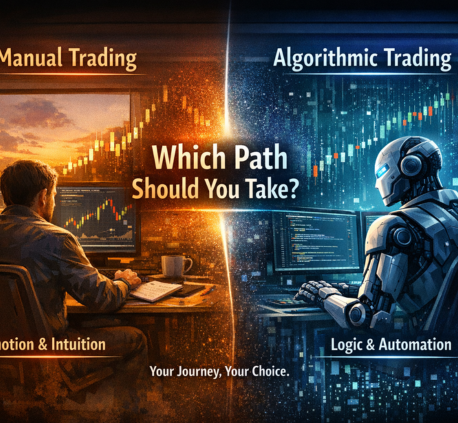
Manual trading is exactly what it sounds like. You watch the charts, read the news, feel the market, and place trades based on your own judgment. Every decision entry, exit, position size goes through your brain first.
For most traders, this is where the journey begins. And there’s a good reason for that.
Manual trading forces you to understand the market. You learn what a support level actually means when price bounces off it three times. You feel the panic of a sudden news-driven spike. You develop pattern recognition that no YouTube course can hand you.
The downside? You’re human. You get tired, emotional, and distracted. You miss setups while you’re making dinner. You hold losing trades longer than you should because letting go feels like admitting you were wrong.
What Is Algorithmic Trading?
Algorithmic (algo) trading means using a computer program a bot or automated system to execute trades based on a predefined set of rules. Instead of you watching the chart and clicking buy, the algorithm does it automatically when conditions are met.
These rules can be simple (“buy when the 9 EMA crosses above the 21 EMA”) or incredibly complex (multi-factor models pulling from news sentiment, order flow, and macro data). The complexity is up to you or whoever built the system.
Algo trading isn’t just for hedge funds anymore. Retail traders now have access to platforms like MetaTrader, TradingView’s Pine Script, Python libraries like backtrader, and tools like TradeStation or NinjaTrader that let you build and run your own strategies.
The Real Differences That Matter to Beginners
Emotion vs. Execution
Manual traders battle themselves constantly. Fear makes you exit a winning trade too early. Greed makes you hold a losing one too long. FOMO drags you into setups that aren’t there.
An algorithm doesn’t care about any of that. It runs its rules. Period. If the rules say sell, it sells — whether the market is crashing or flying.
But here’s the catch most beginners miss: thealgorithm executes your rules, not your wisdom. If the rules are bad, the bot loses money faster than you would manually. It just does it more consistently and at scale.
Time Commitment
Manual trading demands presence. Depending on your strategy (scalping, day trading, swing trading), you might need to be glued to a screen for hours.
Algo trading, once set up, runs without you. You can trade 24/7 markets like crypto or forex without sleeping in shifts. This is one of the biggest genuine advantages for the right person.
Learning Curve
Manual trading has one learning curve: understanding markets.
Algo trading has two: understanding markets and building/managing systems. You need to know enough to recognize when your algorithm is broken versus when the market just shifted. That’s harder than it sounds.
Backtesting and Data
One of algo trading’s superpowers is backtesting running your strategy against years of historical data to see how it would have performed. Manual traders rely mostly on screen time and memory.
Backtesting sounds great until you learn about overfitting building a strategy that looks incredible on past data and falls apart on live markets. It’s one of the most common pitfalls in algo trading.
The Honest Truth About Who Should Switch (and When)
Here’s the question most articles dance around: when is the right time for a beginner to move from manual to algo trading?
The answer isn’t a timeline it’s a checklist.
You’re Ready to Explore Algo Trading When:
1. You have a profitable manual strategy not a theory, an actual edge. This is non-negotiable. If you can’t articulate the exact rules of your strategy (“I enter long when X, Y, and Z conditions are met, with a stop at A and target at B”), you have nothing to automate. You’d just be automating confusion.
2. You’ve traded it live long enough to trust it. A strategy that worked for two weeks isn’t a strategy. You need enough live sample size ideally 50-100+ trades to know the edge is real.
3. You understand why it works. This matters more than most people think. Markets change. If you know the market condition your strategy exploits (momentum breakouts, mean reversion, volatility compression), you’ll know when the algorithm should be turned off. If you’re just chasing backtest results you don’t understand, you won’t know it’s broken until it’s too late.
4. You’re losing time, not edge. If you have a solid strategy but you’re missing setups because you can’t watch the chart all day, or you’re trading tired and making execution errors that’s a strong signal automation would help you.
5. You have basic technical literacy, or you’re willing to develop it. You don’t need to be a software engineer. But you need enough familiarity with your platform’s scripting language, or enough resources to work with someone who does, to build and maintain your system. Being completely helpless when your bot misbehaves is a risky position.
You’re NOT Ready to Switch When:
- You’re still learning the basics of price action, risk management, or market structure
- You’ve been trading for less than 6 months and haven’t found a consistent edge yet
- You’re hoping the algorithm will figure out how to be profitable for you
- You want to automate because you’re frustrated with your manual results (fix the strategy first)
- You don’t have time to monitor and maintain the system properly
A Middle Path Most Beginners Overlook
It doesn’t have to be all or nothing.
Many experienced traders use a hybrid approach: they trade manually in high-conviction setups but automate routine, rule-based entries in the background. Others use automation for trade management (setting stop-losses, trailing stops, take-profits) while entering manually.
This is often a smarter way to start. You keep your judgment in the loop while removing the parts of execution where human emotion does the most damage.
Another overlooked option: semi-automated alerts. Tools like TradingView let you set alerts that notify you when your conditions are met you still place the trade manually, but the algorithm is doing the watching. Lower risk, lower complexity, and a great stepping stone.
Common Myths Worth Debunking
“Algo trading is more profitable.” Not automatically. Performance depends entirely on the strategy. A bad algorithm will lose money faster than a bad manual trader because it scales.
“You need to know how to code.” Not necessarily. Platforms like MetaTrader have drag-and-drop builders. Services likeCryptohopper or 3Commas have pre-built bots. Pine Script on TradingView is beginner-friendly. That said, being able to read and tweak code gives you a major advantage.
“Backtesting proves it works.” Backtesting shows it would have worked on past data. The market doesn’t owe you the same behavior in the future. Always validate on out-of-sample data and test live with small size before scaling.
“Once it’s running, I can forget about it.” Algorithms need maintenance. Markets evolve. A strategy that worked beautifully in a trending 2020 crypto market might bleed out in a choppy 2023 range market. You need to monitor performance regularly.
A Practical Roadmap for Beginners
If you’re serious about eventually making the move, here’s a realistic path:
Stage 1 Build your manual edge (Months 1–12+) Focus entirely on understanding markets. Pick one asset class, one timeframe, one strategy. Journal every trade. Get profitable consistently before thinking about automation.
Stage 2 Write out your rules in exact, testable terms (Ongoing) This alone separates traders who can automate from those who can’t. If your rule is “I buy when it looks strong,” you don’t have a rule. “I buy when price closes above the prior day’s high with RSI above 50 and volume above the 20-day average” — that’s a rule.
Stage 3 Backtest manually first Before writing a single line of code, scroll through historical charts and manually mark where your system would have entered and exited. This builds intuition and catches problems before you invest time coding.
Stage 4 Build a basic version and forward test it Paper trade your automated system alongside your manual trading. Let both run. Compare results over at least 30–50 trades.
Stage 5 — Go live with small size Don’t trust backtesting alone. Live markets have slippage, data gaps, and broker quirks that simulations miss. Start small, watch closely, scale gradually.
The Bottom Line
Algo trading isn’t a shortcut it’s a different tool. For the right trader, at the right time, with the right strategy, it genuinely can free up time, remove emotional bias, and scale a working edge.
But for a beginner who hasn’t yet found that edge, automation just means losing money faster with fewer excuses.
The switch makes sense when you’ve built something worth automating. Until then, the most valuable thing you can do is stay in the trenches watching charts, taking trades, learning from losses and building the understanding that no algorithm can substitute for.
Master the manual. Then, and only then, hand it to the machine.