A few years back, a friend of mine a seasoned equity trader with nearly a decade on Dalal Street told me something that stuck. He said “The day a machine can feel the nervousness in a press conference, I will retire.” He was half joking. But the other half? That’s the real question every trader is quietly asking right now.
Algo trading is not new. Institutions have been running automated strategies since the late 1990s. But what’s changed dramatically almost uncomfortably is the speed at which AI tools are becoming accessible to retail traders. We are not talking about hedge funds anymore. We are talking about a 24-year-old in Pune running a Python-based algo on Zerodha Kite platform with a ₹2 lakh capital account.
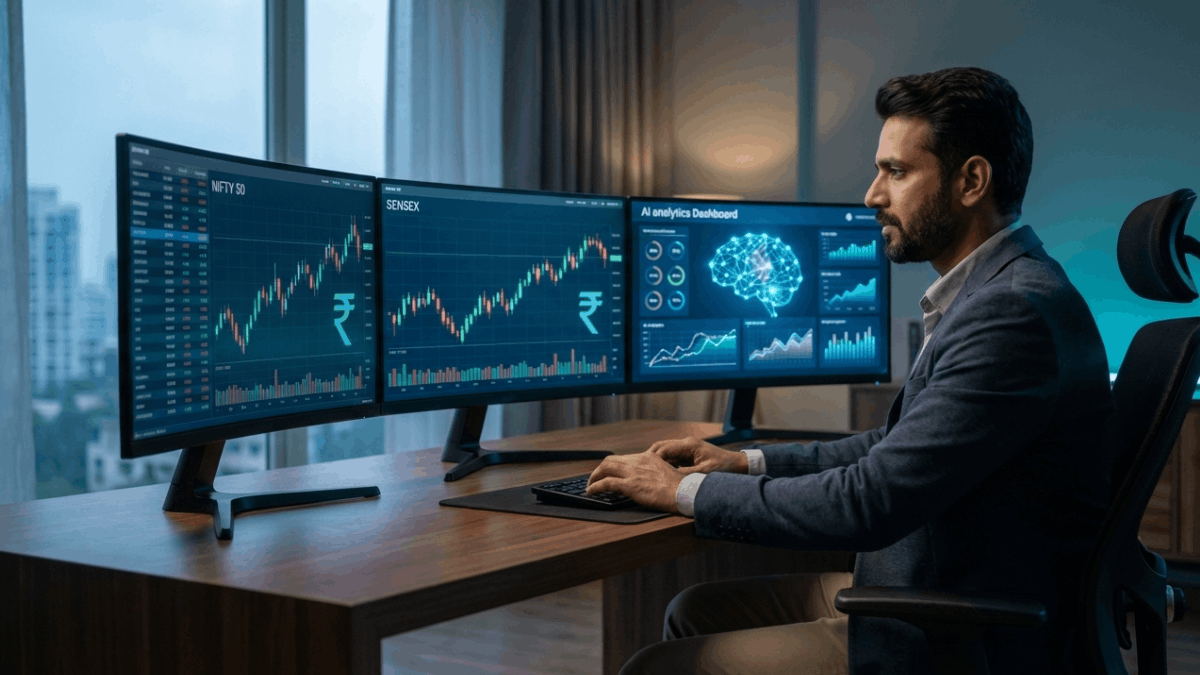
So the question isn’t really whether AI is in stock trading. It clearly is. The real question is: what does that mean for the average human trader sitting in front of three monitors at 9:15 AM?
What Algo Trading Actually Does (And Doesn’t Do)
Here’s the thing most people picture algo trading as some kind of all knowing, infallible robot. It is not. At its core an algo is just a set of rules. “Buy when RSI crosses below 30 and price is above 200 EMA.” That’s an algo. A simple one sure, but the principle holds even for the sophisticated AI driven versions.
What modern AI-based systems add on top of that is pattern recognition at a scale no human can match. They can scan thousands of stocks, news feeds options chains, and even social sentiment simultaneously. They react in milliseconds. A manual trader on the best day of their life cannot compete with that on pure execution speed.
But and this is a significant but speed and pattern recognition are not the same as judgment. Markets don’t always behave like patterns. Sometimes the Reserve Bank of India drops a surprise rate decision. Sometimes a geopolitical event blindsides an entire sector. These are moments where rigid rule based systems can blow up spectacularly because they were never designed for “unprecedented.”
Why Institutions Use It (And Why That Should Concern Retail Traders Slightly)
Large institutional players think proprietary trading desks hedge funds foreign portfolio investors they have been running AI driven strategies for years. High frequency trading firms execute thousands of trades per second profiting from tiny price discrepancies most humans wouldn’t even notice. By the time you see a price move, they’ve already been in and out three times.
This creates an asymmetry. Not insurmountable, but real. Manual retail traders are increasingly competing on a playing field that has more automated participants than ever before. Liquidity might look normal on the surface, but the behaviour of the market especially in derivatives has measurably changed because of algorithmic activity.
And yet, retail traders keep making money. Individual traders with a clear strategy, disciplined risk management, and emotional control continue to thrive. Which tells you something important about what the machines haven’t figured out yet.
The Emotional Edge — Yes, It’s Real
Emotions in trading are usually framed as the enemy. And mostly, they are panic selling revenge trading FOMO chasing. All of these are emotion driven disasters. But there’s a kind of market intuition that experienced traders develop something that’s hard to quantify but genuinely valuable.
Honestly speaking, there’s no algorithm that can read a CFO’s body language during an earnings call and decide the guidance sounds too optimistic. No machine picks up on the fact that a particular stock has been quietly accumulating on unusually low volumes for three weeks and something might be brewing. These are human observations. Subtle often wrong but occasionally right in ways that matter.
The interesting irony is that the more algo dominated the market becomes the more it creates specific inefficiencies that a sharp human trader can exploit. Algos hunt stop losses. They cluster around round numbers. They create predictable patterns that if you know what to look for can actually be traded against. Some of the best manual traders today are essentially trading the algos themselves.
Algo Trading in India: Where Things Stand
India’s algo trading landscape is evolving fast. SEBI has been progressively opening up algorithmic trading access to retail participants, though regulatory guardrails remain stricter compared to Western markets. As of now, retail algo trading through API access is growing rapidly platforms like Zerodha, Dhan, and Upstox have made it significantly more accessible.
What’s also interesting is that a lot of the “AI trading” being discussed in retail circles is honestly just basic automation wrapped in fancier language. True machine learning-based adaptive trading systems are still largely in institutional territory. Most retail algos are rule-based smarter and faster than a human clicking buttons, but not genuinely “intelligent” in any deep sense.
That said, the trajectory is clear. Tools are getting better. The barrier to entry is dropping. And traders who understand both the mechanics of the market and the capabilities (and limitations) of these systems are going to have a significant advantage over those who don’t.
If you’re a trader who’s curious about building that kind of edge the combination of market fundamentals and systematic thinking structured education makes a real difference. Institutions like Vaishvik Traders have been covering algo trading as part of their curriculum alongside manual strategies, which is probably the right approach for anyone serious about longevity in this game.
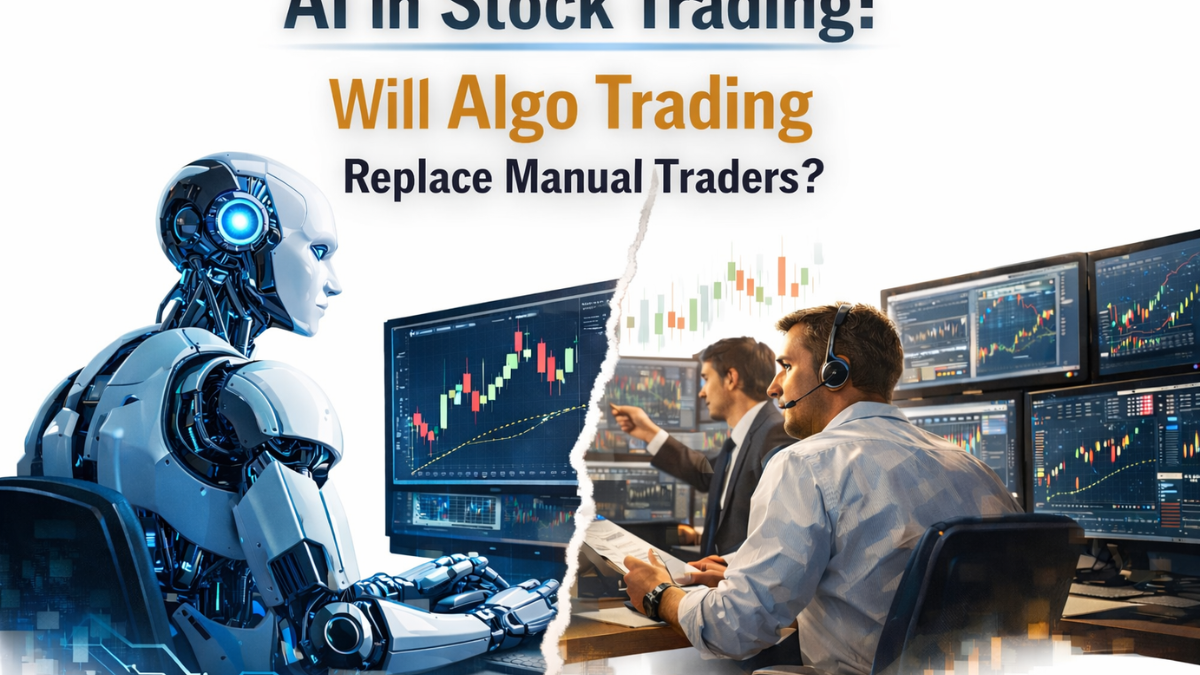
So, Will Algo Trading Actually Replace Manual Traders?
Short answer: no. Longer answer: it depends on what kind of manual trader you are.
If your edge is purely about reacting faster than others, or running strategies that algos can easily replicate that edge is probably eroding. There’s no kind way to say it. A strategy that was working five years ago purely on speed advantage might not work the same way today.
But if your edge is built on genuine market understanding, adaptive thinking, and disciplined risk management? That’s not going away. If anything, the algorithmic noise is creating more opportunities for traders who can stay calm and think clearly when automated systems are overcorrecting.
Think about what happened during the COVID crash in March 2020. Algo systems didn’t “understand” a pandemic. Many got triggered by their own stop-loss cascades, amplifying the fall. But traders who recognised that the selloff was indiscriminate that fundamentally sound companies were being thrown out with the garbage made some of the best trades of their careers in those weeks.
Machines follow patterns. Humans can recognise when patterns don’t apply. That distinction is worth a lot.
The Practical Middle Ground
Plenty of traders today are using a hybrid approach using algorithms for screening, entry signals and execution, while reserving judgment calls for themselves. This honestly seems like the most sensible path for most retail participants. You are not trying to out-compute an institution. You are leveraging automation where it genuinely helps while staying in control of the decisions that require context.
Learning to build or understand even a basic algo isn’t just a technical skill anymore it’s market literacy. Knowing how other market participants are automated gives you a mental model for why certain price movements happen the way they do. It’s the same reason understanding large option positions helps you anticipate where markets might be pinned on expiry.
The traders who will struggle in the next decade aren’t the ones using algos or the ones trading manually. They are the ones who pick a side and ignore the other entirely.
A Few Questions People Often Ask About This
Will AI eventually beat every human trader consistently?
Probably in certain narrow, well-defined strategies yes, eventually. But markets are adaptive systems. The moment an AI strategy becomes too successful and widespread, the market adapts and the edge disappears. Alpha is always temporary. That’s true for humans and machines alike.
Is algo trading legal for retail traders in India?
Yes, though with conditions. SEBI permits retail algorithmic trading via API access through registered brokers. You need to ensure your broker supports it and that your strategy complies with SEBI’s algo trading guidelines. It’s worth reading up on this specifically before you start.
Do I need to know coding to use algo trading?
Not necessarily, but it helps. There are no-code/low-code platforms emerging that let you build rule-based strategies without writing a single line of Python. That said, if you understand even basic logic and conditions, you will have far more flexibility and control over what you are actually running.
Can a beginning trader benefit from algos?
This is where most people get it backwards. Beginners often think automation will compensate for not understanding the market. It won’t. A bad strategy automated is just a faster way the traders lose money. The foundation has to be market knowledge first. Automation is a multiplier it multiplies whatever you already have, good or bad.
The conversation around AI and trading is going to keep getting louder. That’s fine. But don’t let the noise make you feel like the human element in trading is becoming irrelevant. It isn’t. If anything, in a world of machines following rules, the trader who understands why the rules sometimes break may have more of an edge than ever.