You’ve been watching gold prices move. You’ve read a few articles. Maybe you’ve even paper-traded once or twice. Now you’re wondering is it time to start trading gold and silver on MCX for real?
This guide answers that question honestly. Not with fluff, but with the actual mechanics, the risks, and a clear-eyed look at when a beginner is truly ready to step in.
What Is MCX and Why Does It Matter for Precious Metals?
The Multi Commodity Exchange of India (MCX) is the country’s largest commodity derivatives exchange. It accounts for over 85% of India’s commodity futures trading volume — and gold and silver are its most actively traded contracts.
For anyone looking to participate in precious metals markets beyond buying physical jewellery or sovereign gold bonds, MCX is the primary battleground. Prices are quoted inIndian Rupees per 10 grams (gold) or per kilogram (silver), making it highly relevant for domestic investors.
Understanding the Gold and Silver Contracts on MCX
Before you place your first trade, you need to know what you’re actually buying.
Gold Contracts
MCX offers multiple gold contract sizes to suit different trader profiles:
- Gold (1 kg) — The standard lot. High capital requirement, meant for experienced traders and institutions.
- Gold Mini (100 grams) — A more accessible option for retail traders.
- Gold Guinea (8 grams) — Designed for smaller participants and hedgers.
- Gold Petal (1 gram) — The most beginner-friendly entry point on the exchange.
The lot size directly determines your exposure. Trading a 1 kg Gold contract at ₹72,000 per 10 grams means you’re controlling approximately ₹72 lakh worth of gold. Margins typically run between 4–6%, so you’d need around ₹3.5–4.5 lakh as initial margin — for a single lot.
Silver Contracts
- Silver (30 kg) — Standard contract, significant capital needed.
- Silver Mini (5 kg) — More manageable for retail traders.
- Silver Micro (1 kg) — Ideal for beginners testing their strategies.
Silver is more volatile than gold and generally requires less capital per lot — but that volatility cuts both ways.
How MCX Gold and Silver Trading Actually Works
Step 1: Open a Commodity Trading Account
You need a broker registered with MCX and SEBI. Most major brokers — Zerodha, Angel One, ICICI Direct, Upstox — offer commodity trading as part of their platform. You’ll need your PAN, Aadhaar, and bank account details for KYC.
Step 2: Understand Futures Contracts
MCX trades are futures contracts, not spot purchases. This means:
- You’re agreeing to buy or sell a fixed quantity at a predetermined price on a future date.
- You don’t need to take physical delivery — most retail traders square off (close) their positions before expiry.
- Contracts have monthly expiry cycles. Near-month contracts are the most liquid.
Step 3: Learn How Margin Works
Margin in commodity futures is your “good faith deposit.” There are two components:
- Initial Margin: The amount required to open a position (typically 4–8% of contract value).
- Mark-to-Market (MTM): Daily gains and losses are credited or debited to your account. If the market moves against you, your broker will issue a margin call requiring you to top up.
This is where many beginners get caught off guard. The leverage amplifies both profits and losses.
Step 4: Read the Price Quotes Right
Gold is quoted in ₹ per 10 grams. Silver is quoted in ₹ per kg. One point (tick) movement in gold equals ₹1 per 10 grams. For a 100-gram Gold Mini contract, that’s ₹10 per tick. For the 1 kg standard contract, it’s ₹100 per tick.
Knowing your tick value before you trade is non-negotiable.
Step 5: Place Your Trade
You can go long (buy) if you expect prices to rise, or short (sell) if you expect them to fall. Set your entry, your stop-loss, and your target before you click the button — not after.
What Moves Gold and Silver Prices on MCX?
Domestic MCX prices are influenced by a combination of global and local factors:
Global factors:
- US Dollar Index (DXY) — Gold and the dollar typically move inversely.
- US Federal Reserve interest rate decisions.
- Geopolitical tensions and global risk sentiment.
- COMEX gold and silver prices (international benchmark).
Domestic factors:
- USD/INR exchange rate — A weaker rupee makes imports more expensive and pushes MCX prices higher.
- Indian import duties on gold (currently 15%, though subject to change).
- Seasonal demand — Dhanteras, wedding season, and harvest festivals significantly impact physical demand.
- RBI policy and domestic inflation.
If you understand these drivers, you’re already thinking like a trader, not just a speculator.
When Should Beginners Make the Switch to Live MCX Trading?
This is the real question, and it deserves a real answer.
Most beginners rush this decision. They see gold rally ₹2,000 in a week, calculate what they “could have made,” and open a live account the next morning. That’s not readiness — that’s FOMO.
Here are the honest signals that you’re ready:
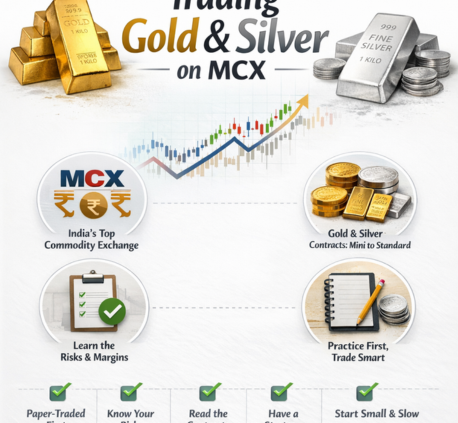
✅ You’ve Paper-Traded for at Least 30–60 Days
Paper trading (simulated trading without real money) isn’t glamorous. But it forces you to practice entries, exits, and position sizing without financial consequences. If you can’t be disciplined with fake money, you won’t be disciplined with real money.
✅ You Understand Your Risk Per Trade — Before You Trade
A beginner who can say “I’m risking ₹5,000 on this trade, my stop-loss is at X, and my target gives me a 1:2 risk-reward” is more prepared than someone with five years of casual market watching. Define your risk. Every time.
✅ You’ve Read the Contract Specifications
This sounds tedious. Do it anyway. Know the lot size, expiry date, tick size, margin requirement, and delivery mechanism for the contract you plan to trade. MCX publishes these on their official website.
✅ You Can Afford to Lose What You’re Putting In
No responsible trader tells you this enough: only trade with money you can afford to lose entirely. Not your emergency fund. Not borrowed capital. Commodity markets are leveraged instruments — drawdowns happen fast.
✅ You Have a Strategy, Not Just a View
“I think gold will go up” is not a strategy. A strategy includes: entry criteria, stop-loss level, profit target, position size, and what conditions would make you sit out. If you can write yours down in five sentences, you’re ready to test it with a small position.
Beginner’s Starting Point: The Practical Approach
If you’re new and want to start cautiously, here’s a sensible path:
Start with Gold Petal (1 gram) or Silver Micro (1 kg). These are the smallest contracts and let you experience live market conditions — slippage, margin calls, emotional pressure — without catastrophic downside.
Trade only near-month contracts. They have the highest liquidity, meaning tighter bid-ask spreads and easier exits.
Avoid overnight positions initially. Intraday positions avoid the overnight risk of a sharp international move (a Fed announcement, a geopolitical event) gapping your position against you while you sleep.
Keep a trading journal. After every trade, write down why you entered, what happened, and what you’d do differently. This single habit separates traders who improve from those who just repeat mistakes.
Common Mistakes Beginners Make on MCX
Being aware of these doesn’t guarantee you’ll avoid them — but it helps.
Over-leveraging: Taking a position so large that a small adverse move wipes out a significant chunk of your capital. Keep leverage conservative, especially early on.
Ignoring the expiry date: If you forget to square off before expiry and hold a delivery-settled contract, you could be obligated to take or give physical delivery. Always know when your contract expires.
Trading on tips: MCX trading groups and WhatsApp channels are full of “sure shot calls.” Most of them are noise. Trading someone else’s calls without understanding why means you won’t know when they’re wrong.
Letting losers run, cutting winners short: This is the opposite of what good trading looks like. Respect your stop-loss. Let your targets breathe.
Confusing gold as “safe”: Physical gold is a store of value. Gold futures are a leveraged derivative. They are not the same thing. Treat them accordingly.
MCX vs. Other Ways to Invest in Gold and Silver
It’s worth knowing what you’re choosing over:
| Option | Suitable For | Liquidity | Leverage |
|---|---|---|---|
| MCX Futures | Active traders | High | Yes |
| Sovereign Gold Bonds | Long-term investors | Low–Medium | No |
| Gold ETFs | Passive investors | Medium | No |
| Physical Gold | Traditional savers | Low | No |
| Digital Gold | Small savers | Medium | No |
MCX is not the right vehicle for everyone. If your goal is long-term wealth preservation, Gold ETFs or SGBs are better suited. MCX is for those who want to actively trade price movements and are willing to put in the work to do it properly.
Final Word
Trading gold and silver on MCX can be genuinely rewarding — but the market doesn’t care about your confidence, your conviction, or how much you’ve read. It only reflects price, and price is humbling.
The best time to make the switch from watching to trading isn’t when you feel most excited. It’s when you feel most prepared. When you’ve done the groundwork, know your numbers, and have a plan you can execute without panicking.
Start small. Stay disciplined. Learn from every trade. The market will still be there when you’re ready.