SEO Title: What Is a Demat Account? Complete Beginner’s Guide to Start Trading in India (2026) Meta Description: New to the stock market? This guide explains what a demat account is, how to open one in under 24 hours, which broker to pick, and how to place your very first trade in India in 2026. Focus Keyword: what is a demat account | how to start trading in India 2026 Slug: what-is-demat-account-how-to-start-trading-india-2026
You’ve seen the news. Friends are talking about Nifty. Someone in your office made money on an IPO. You’ve heard the words “demat account” at least a dozen times — and you have a vague idea it has something to do with the stock market.
But here’s the thing nobody tells you clearly: what exactly is a demat account, why do you need one, and how do you actually go from zero to placing your first trade?
This guide is going to answer all of that. Step by step. No assumed knowledge.
By the time you finish reading, you’ll know exactly what a demat account does, how to open one today, which broker to pick in 2026, and what to actually do once the account is live.
First, Let’s Kill the Confusion: What Is a Demat Account?
Think of a demat account the way you think of a bank account except instead of storing money, it stores your investments.
When you buy shares of Reliance, TCS, or any other company listed on the NSE or BSE, those shares don’t come to you as a physical paper certificate anymore. They exist digitally and your demat account is where they are held.
The word “demat” is short for dematerialised. Before 1996, buying shares in India meant receiving actual paper certificates documents that could be lost, forged, stolen, or damaged. In 1996, SEBI introduced demat accounts in India, which revolutionised investing by making it a fully digital process. You now hold shares, bonds, ETFs, government securities, and even mutual funds in electronic form inside a single account safe, accessible, and trackable from your phone.
One important distinction that confuses beginners: A demat account and a trading account are two different things but they almost always come together.
- Your trading account is where you place orders (buy/sell).
- Your demat account is where your shares are stored after purchase.
When you buy shares, they are automatically credited to your demat account. When you sell, they are debited from your account on the settlement date. The trading account is used to place buy and sell orders, while the demat account holds the actual shares, mutual funds, bonds, and ETFs in digital form.
In practice, when you open an account with any modern broker today, you get both — and they function as one seamless experience.
How Big Has This Become in India?
Here’s a number that tells you just how much India’s relationship with the stock market has changed.
The number of demat accounts in India has more than quadrupled in the last five years — from 50 million in 2020 to 216 million by end of 2025.
That’s 21.6 crore accounts. To put it in perspective, that’s more accounts than the entire population of Brazil.
The growth is being driven by younger investors under 30 from smaller towns opening accounts through digital platforms — a structural shift that experts say is moving Indian households away from gold and fixed deposits toward financial assets.
If you haven’t opened one yet, you’re not late. But you’re definitely not early either. The people around you are already in.
What Can You Actually Do With a Demat Account?
A demat account isn’t just for buying stocks. Once your account is open, you can invest in:
- Equity shares — stocks of individual companies listed on NSE and BSE
- Mutual funds — both regular and direct plans
- ETFs — Nifty 50 ETF, Gold ETF, sector ETFs
- IPOs — apply for new company listings directly
- Bonds and government securities — fixed income products
- Futures and Options — advanced derivatives (once you’re ready)
Most beginners start with one or two of these and gradually expand. There’s no pressure to use everything on day one.
What Documents Do You Need? (Keep These Ready)
The demat account opening process is simple if your documents are ready. PAN card, Aadhaar linked to your mobile number, and basic bank proof cover most cases. Missing or mismatched details cause most delays.
Here’s the exact checklist:
| Document | Purpose |
|---|---|
| PAN Card | Mandatory — no exceptions |
| Aadhaar Card | Identity + address proof (must be linked to mobile) |
| Bank account details | Cancelled cheque or passbook with IFSC code |
| Passport-size photo | For KYC |
| Signature | For e-sign during application |
| Income proof (optional) | Required if you want to trade in F&O from day one |
That’s genuinely it. If you have these ready, the entire process can be completed on your phone in one sitting.
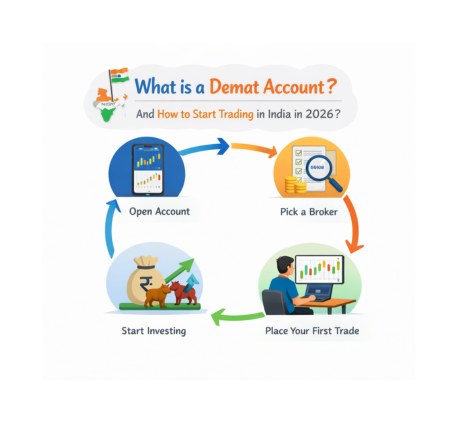
How to Open a Demat Account in 2026: Step by Step
Online demat account opening in India typically takes 24–48 hours. With digital KYC and video verification, you no longer need physical paperwork or branch visits.
Here’s how the process works across every major platform:
Step 1: Choose your broker (more on this below) Go to their website or download their app.
Step 2: Enter your mobile number and verify via OTP This links your identity to the application.
Step 3: Enter your PAN and date of birth The system cross-references your details with the Income Tax database automatically.
Step 4: Complete e-KYC using Aadhaar You’ll enter your Aadhaar number, OTP, and 6-digit DigiLocker PIN to verify your KYC — entirely online, no scanning or uploading of physical documents required.
Step 5: Upload bank proof A photo of your cancelled cheque or bank passbook showing your name, account number, and IFSC code.
Step 6: In-Person Verification (IPV) This sounds more complicated than it is. You simply turn on your phone camera and show your face for a few seconds — the platform records a brief video clip to confirm you’re a real person.
Step 7: e-Sign the application Done via Aadhaar OTP. No printing, no ink signature, no courier.
Step 8: Wait for approval Once the application is submitted and verified, the DP activates your demat account, usually within one to two business days.
You’ll receive your login credentials, a 16-digit Client ID (this is your demat account number), and you’re ready to go.
Which Broker Should You Choose in 2026?
This is the question that trips up most beginners. There are dozens of options. Here’s an honest breakdown of the three that dominate the market for new investors:
Zerodha — Best for Serious Learners
Zerodha was India’s first major discount broker and built its reputation on low brokerage, a strong and stable platform, and tools like Kite that are built for traders who want control and depth.
- Account opening: Free
- Equity delivery trades: ₹0 brokerage (you pay nothing to buy and hold stocks)
- Intraday/F&O: Flat ₹20 per order
- Demat AMC: ₹300/year
- Best for: People who are serious about learning, want advanced charting, and plan to actively trade
The one catch: Zerodha doesn’t offer research recommendations or tips. You need to learn to make your own calls. That’s actually a feature if you’re building real skills — but it’s something to be aware of.
Groww — Best for Absolute Beginners
Groww is loved by first-time investors for its minimalist, clutter-free design that makes onboarding effortless. If you’re just starting your investment journey or prefer a simple experience, Groww is the smooth entry gate.
- Account opening: Free
- Demat AMC: Free (this is the big advantage over Zerodha)
- Intraday/F&O: Flat ₹20 per order
- Best for: Complete beginners, SIP investors, mutual fund buyers
The trade-off: Groww doesn’t support commodity and currency trading, so if you want to eventually trade gold on MCX or forex, you’ll need to open a second account elsewhere.
Upstox — Best Middle Ground
Upstox, backed by Ratan Tata and Tiger Global, balances professional tools with accessibility for Tier-2 and Tier-3 city users — making it popular for investors who want more than Groww but aren’t ready for the depth of Zerodha’s platform yet.
- Account opening: Free
- Demat AMC: ₹150/year (first year free)
- Intraday/F&O: Flat ₹20 per order
- Best for: Beginners who also want commodity and currency trading access
Vaishvik Traders is an authorized partner with both Upstox and Dhan — which means if you open an account through them, you get guided support through the process and mentorship from day one. Not a bad place to start.
You Have a Demat Account. Now What?
This is where most beginners get stuck. The account is open, the money is transferred — and then the screen looks intimidating, with price tickers moving and numbers flashing everywhere.
Here’s a grounded starting point:
Don’t Start With a Random Stock
The biggest mistake beginners make is buying a stock because a friend recommended it, or because they saw it trending on social media. Without understanding what you’re buying, you’re not investing — you’re gambling with extra steps.
Start With a Nifty 50 Index Fund or ETF
If you genuinely don’t know where to begin, a Nifty 50 index fund is the single most sensible first step for most Indians. You’re not picking individual companies — you’re buying a small piece of India’s 50 largest corporations. One purchase, instant diversification.
You can start a SIP (Systematic Investment Plan) with as little as ₹500 per month. It’s boring. It works.
Learn to Read a Basic Chart Before Going Into Intraday
Between FY22 and FY25, retail investors in India lost close to ₹3 lakh crore in derivatives trading — SEBI estimated that 91% of retail derivatives traders lost money during this period.
That’s not a reason to be afraid of the market. It’s a reason to be educated before you trade. Intraday trading and options are not beginner activities. They require understanding price action, risk management, and trading psychology — things that take real time to learn.
Open the account. Start with long-term investing while you learn. Graduate to active trading only after you actually understand what you’re doing.
The Most Common Questions Beginners Ask (Answered Directly)
Is there a minimum amount needed to open a demat account? No. There is no minimum balance required to open a demat account in India. You can open one with ₹0 and add funds whenever you’re ready.
Can a student or salaried person open one? Yes, absolutely. Any Indian resident above 18 with a PAN card and Aadhaar can open one. Minors can also have a demat account opened in their name through a parent or legal guardian, with the guardian operating it until the child turns 18.
What happens if I open an account and don’t use it? Nothing serious — you simply pay the annual maintenance charge if your broker levies one. You can also close it formally if you no longer want it.
Can I have more than one demat account? Yes, it is possible to have more than one demat account. Some investors open a second account to separate long-term holdings from active trading. Zerodha now offers this facility officially.
Is my money safe in a demat account? Your demat account is regulated by SEBI and maintained through NSDL or CDSL — India’s two government-recognized depositories. SEBI oversees the functioning of demat accounts and the securities stored in them are held in your name, not the broker’s. Even if a broker shuts down, your holdings are safe.
One Last Thing Worth Saying
Opening a demat account is the easiest part. A five-minute process on an app.
What happens after that is what actually determines whether you build wealth or lose money chasing random tips on WhatsApp groups.
The investors who consistently do well in India’s market are not the ones who found the best hidden stock. They’re the ones who understood what they were buying, managed their risk properly, and didn’t panic when the market went red for three months.
Experts looking at India’s market in 2026 say the focus needs to shift from the number of demat accounts to the quality of participation — deeper, more intelligent investing rather than just more accounts being opened.
Opening the account puts you in the game. Learning the game is what keeps you there.
If you’re based in Jaipur and want structured, practical guidance from live market sessions — not YouTube videos or random tips — that’s exactly what Vaishvik Traders is built for.