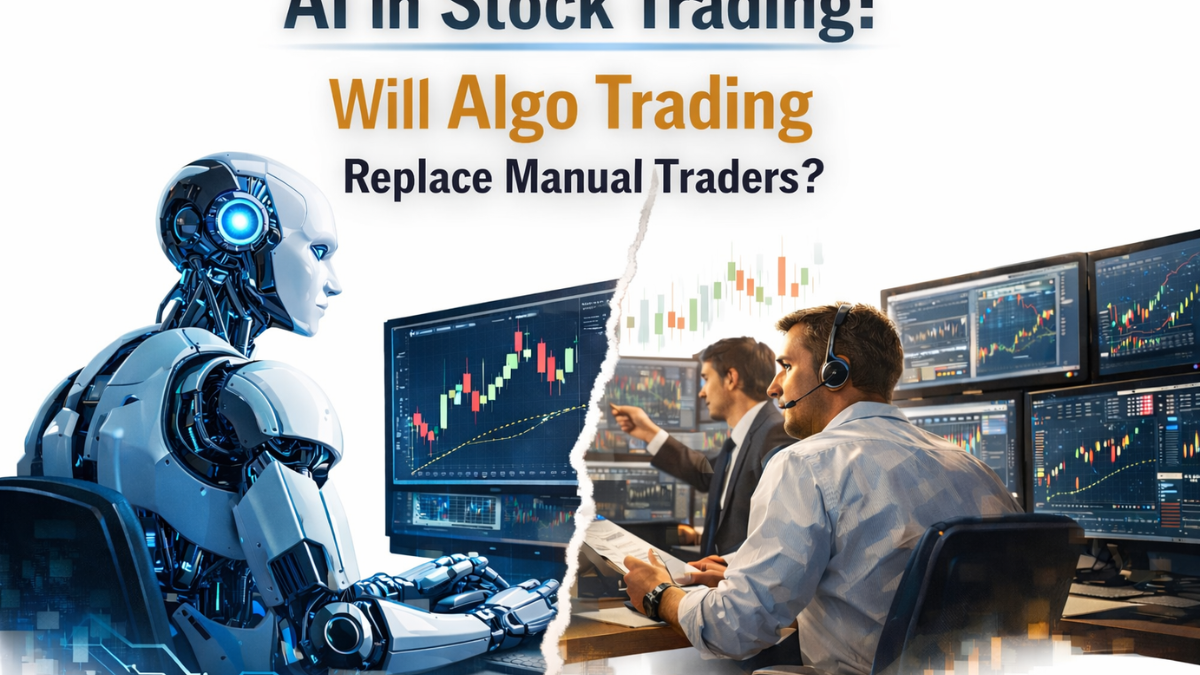
The artificial intelligence revolution isn’t just changing technology – it’s transforming stock markets worldwide. While U.S. tech giants like Nvidia and Microsoft grab headlines with record-breaking gains, Indian traders are asking: Should I jump into AI stocks, or am I too late to the party?
Let’s cut through the hype and look at what’s really happening in AI markets, how Indian traders can participate, and whether this boom is an opportunity or a trap for beginners.
The Global AI Stock Boom: What’s Driving It?
Microsoft’s Azure cloud services revenue jumped 40% year-over-year, driven by generative AI demand. Nvidia trades at a forward price-earnings ratio of 42.1, while analysts project 36% upside potential. Some analysts believe Nvidia could reach a $6 trillion market capitalization by the end of 2026.
The numbers tell a clear story: AI isn’t hype anymore—it’s driving real revenue growth.
Here’s what’s fueling the fire:
Hardware Infrastructure Boom: Companies need massive computing power to train AI models. Nvidia dominates the AI chip market with GPUs powering most training and inference systems. Demand is so strong that supply can’t keep up, even with billion-dollar production expansions.
Cloud Services Explosion: Microsoft integrates AI across Azure, Office suite, and enterprise tools, offering multiple revenue channels. Every company wanting to use AI needs cloud infrastructure, creating a recurring revenue goldmine for providers.
Enterprise AI Adoption: Palantir posted sales of $1.18 billion with a net income of $475.6 million in Q3 2025. Businesses aren’t just experimenting anymore—they’re deploying AI systems that directly impact their bottom line.
Real Revenue, Not Just Promises: CoreWeave went from minimal sales in 2022 to $1.9 billion in 2024 and is expected to generate more than $10 billion in revenue in 2026. These aren’t hypothetical projections—companies are seeing explosive growth right now.
The AI infrastructure build-out is creating wealth at a pace we haven’t seen since the early days of the internet.
The Indian IT Reality Check: Why Our Stocks Are Struggling
Now here’s the uncomfortable truth Indian traders need to face: while global AI stocks soar, Indian IT companies are getting hammered.
The February 2026 Crash: Indian IT stocks came under heavy pressure on February 4 as a global tech selloff weighed on investor sentiment, with the Nifty IT index down over 7%. Infosys saw its shares plunge over 8%, marking its steepest single-day fall in more than two and a half years. The fall wiped out nearly ₹2 lakh crore in market capitalisation from India’s leading IT companies in a single session.
What triggered this bloodbath?
Anthropic recently launched plug-ins for its Claude Cowork agent, designed to automate tasks across legal, sales, marketing and data analysis functions. These are exactly the kinds of services that Indian IT companies have been selling for decades.
The market’s message was brutal: If AI can automate these tasks, why do we need thousands of Indian engineers doing them manually?
The “SaaSpocalypse” Fear: The term refers to a market fear that AI will replace software-as-a-service and IT service companies rather than just helping them, leading to a collapse in traditional business models.
But Is the Fear Justified?
Tech Mahindra CEO Mohit Joshi dismissed the market response as a “clear overreaction”. Analysts from Nirmal Bang noted that new technology or plug-ins cannot immediately replace old technology debt and a bridge is needed which is provided by companies like Indian IT firms.
The reality is nuanced. Indian IT companies aren’t going extinct overnight, but they’re facing a fundamental business model threat. The era of linear growth linked to headcount is likely ending. Companies like TCS and Infosys must now focus on selling results rather than hours.
The Recovery Outlook: Motilal Oswal forecasts AI services demand to experience a meaningful uplift starting mid-2026 as hardware-led AI capital expenditure moderates and spending shifts towards software, platforms, and associated services.
So there’s hope – but only for IT companies that successfully pivot to selling AI-powered solutions instead of just providing bodies.
How Indian Traders Can Access Global AI Stocks
If you want exposure to the real AI revolution – not just companies hoping to survive it – you need access to U.S. markets. Here’s how:
Option 1: Direct U.S. Stock Investment (Most Recommended)
Platforms like INDmoney, Winvesta, and Vested allow you to invest directly in U.S. stocks.
The process:
- Open an account (15-minute digital KYC with PAN and Aadhaar)
- Fill out Form W-8BEN (reduces dividend tax from 30% to 25%)
- Transfer money using RBI’s Liberalised Remittance Scheme (LRS) – up to $250,000 per year
- Start buying! You can purchase fractional shares, so you don’t need ₹1 lakh to buy one Nvidia share
Advantage: Direct ownership of shares, full exposure to U.S. market performance, ability to hold long-term
Considerations: You’ll pay 12.5% tax on long-term capital gains in India (after 2 years) plus currency conversion costs
Option 2: AI-Focused ETFs
If picking individual stocks feels overwhelming, AI-themed ETFs give you diversified exposure.
Popular options accessible to Indian investors:
- Invesco QQQ (tracks Nasdaq-100, includes top AI companies)
- Various AI-specific ETFs through platforms like INDmoney
Advantage: Instant diversification, professional management, less research required
Disadvantage: ETF fees, less control over individual holdings
Option 3: Indian Mutual Funds with U.S. Exposure
Some Indian mutual funds invest in international stocks, giving you indirect U.S. market access.
Advantage: No LRS paperwork, rupee-based investing, familiar process
Disadvantage: Limited AI-specific exposure, taxed as debt funds in India, higher expense ratios
Option 4: GIFT City NSE IFSC (Unsponsored Depository Receipts)
The NSE International Exchange in GIFT City offers “receipts” of major U.S. stocks.
Advantage: India-regulated, no LRS hassle for small amounts
Disadvantage: Limited stock selection, lower liquidity than direct U.S. investing
The Top 5 AI Stocks for Indian Traders in 2026
Based on analyst consensus and market position, here are the most compelling AI plays:
1. Nvidia (NVDA) – The AI Infrastructure King
Nvidia commands a market valuation of $4.6 trillion and trades at a forward price-earnings ratio of 42.1. Based on the estimates of 48 analysts, Nvidia commands a “Strong Buy” rating with a mean price target of $256 implying an upside potential of 36.1%.
Why it matters: Nvidia’s GPUs are the pick-and-shovels of the AI gold rush. Every company building AI models needs their chips.
Risk: High valuation, competition from AMD and custom chips by cloud providers
2. Microsoft (MSFT) – The AI Everything Company
Microsoft has a $625 price target with +28% upside and integrates AI across Azure, Office suite, and enterprise tools. From fiscal 2025 to fiscal 2028, analysts expect Microsoft’s revenue and EPS to grow at CAGRs of 47% and 45%.
Why it matters: Microsoft’s OpenAI partnership gives it first-mover advantage in enterprise AI. Copilot is already generating billions in recurring revenue.
Risk: Dependence on OpenAI relationship, intense competition
3. Alphabet/Google (GOOGL) – The AI Data Giant
Alphabet’s forward P/E ratio is hovering around 28 and the company is on the cusp of unlocking a new wave of growth in cloud infrastructure.
Why it matters: Google has more data than anyone and has been doing AI longer than most. Their custom TPU chips reduce dependence on Nvidia.
Risk: Regulatory pressures, search disruption concerns
4. Palantir (PLTR) – The Enterprise AI Software Play
Palantir has a $230 price target with +25% upside and focuses on AI platforms for government and enterprise clients.
Why it matters: Palantir sells AI that actually does work—analyzing data for defense agencies and Fortune 500 companies.
Risk: High valuation, customer concentration, execution risk
5. CoreWeave (CRWV) – The Pure-Play AI Infrastructure Bet
CoreWeave is expected to generate more than $10 billion in revenue in 2026, growing from minimal sales in 2022.
Why it matters: Pure exposure to AI infrastructure demand without the baggage of legacy businesses.
Risk: Microsoft accounted for 62% of revenue in 2024, and the company carries heavy debt and large capital expenditures. This is a high-risk, high-reward play.
Should You Also Consider Indian AI Stocks?
While Indian IT stocks face challenges, some companies are genuinely pivoting to AI:
TCS, Infosys, HCL Tech – For large-cap companies, Motilal Oswal’s preferred picks are Infosys and Tech Mahindra. These companies have strong balance sheets and are investing heavily in AI capabilities.
The case for Indian AI stocks:
- Cheaper valuations after the recent crash
- Government support through National AI Mission
- Talent pool and cost advantage
- Recovering demand expected from mid-2026
The case against:
- Business model disruption risk
- Slower adoption of AI compared to building it
- Lower margins as services get commoditized
Bottom line: Indian IT stocks might recover, but they’re defensive plays, not growth plays. If you want AI exposure for growth, look global.
Beginner Mistakes to Avoid with AI Stocks
1. Chasing Headlines Without Understanding the Business Just because a company mentions “AI” doesn’t make it an AI stock. Many companies slap “AI-powered” on marketing materials without real AI revenue.
2. Ignoring Valuation Completely Yes, AI is the future. No, that doesn’t mean any price is justified. NVDA stock trades at a forward PE ratio of 42.1 but also has a price-earnings-to-growth ratio of 0.91, indicating valuations remain attractive. Always check if growth justifies the premium.
3. Going All-In on One Stock Even Nvidia could stumble. Diversify across the AI stack—chips, cloud, software, applications.
4. Panic-Selling During Corrections AI stocks took a hit on news about the Chinese AI lab DeepSeek in late January 2025 and tariffs in April. Every growth sector has volatility. If the fundamentals are intact, use dips to add positions.
5. Forgetting Currency Risk Your returns in U.S. stocks depend on both stock performance and USD/INR exchange rates. The rupee has historically depreciated 3-5% annually against the dollar – which actually helps your returns when converting back to rupees!
6. Not Understanding Tax Implications Long-term capital gains (held >2 years) on U.S. stocks are taxed at 12.5% in India without indexation. Plan accordingly.
The Verdict: Should You Join the AI Party?
Yes, but with realistic expectations.
The AI revolution is real. Companies are spending hundreds of billions building AI infrastructure, and that money is flowing to the picks-and-shovels providers—chip makers, cloud platforms, and infrastructure companies.
Indian traders who want growth exposure should absolutely consider global AI stocks, but not at the expense of a diversified portfolio.
A balanced approach for beginners:
- 60% Core Portfolio: Solid Indian blue-chips and index funds
- 25% Growth Allocation: U.S. AI stocks (mix of individual stocks and ETFs)
- 15% Opportunistic Plays: Indian IT stocks at current depressed valuations (if you believe in the recovery thesis)
For more aggressive traders:
- Increase U.S. AI allocation to 40-50%
- Focus on leaders (Nvidia, Microsoft, Alphabet)
- Add smaller positions in high-growth plays like CoreWeave or Palantir
The AI boom isn’t over—it’s just getting started. The strongest opportunities in 2026 are coming from the companies building and deploying AI at scale.
But remember: you’re not investing in AI. You’re investing in companies that profit from AI. Know what you own, understand the risks, and never invest money you can’t afford to lose.
Ready to Start Trading?
At Vaishvik Traders, we teach you not just what to trade, but how to think like a successful trader. Our courses cover:
- Global market analysis (including U.S. markets)
- Fundamental analysis for evaluating growth stocks
- Technical analysis for timing your entries and exits
- Risk management to protect your capital
Whether you’re interested in Indian stocks, U.S. AI stocks, or forex trading, we give you the skills to make informed decisions.
Book your free demo class and learn how to participate in global market opportunities—the right way.
Disclaimer: This article is for educational purposes only and does not constitute investment advice. Always conduct your own research and consult with a qualified financial advisor before making investment decisions. Past performance does not guarantee future results.
The stock market is no longer just about gut feelings and manual chart analysis. In 2026, artificial intelligence has become the secret weapon that levels the playing field between institutional traders and retail investors. Whether you’re a beginner trader or an experienced investor looking to sharpen your edge, AI tools can help you make faster, smarter, and more data-driven trading decisions.
But here’s the reality: AI won’t make you rich overnight. What it will do is give you access to the same kind of market intelligence that was once reserved for hedge funds and professional traders. From analyzing news sentiment to detecting chart patterns in milliseconds, AI is transforming how we trade – and it’s more accessible than ever before.
In this comprehensive guide, we’ll explore exactly how beginners can leverage AI tools for stock trading, which platforms are worth your attention, and how Vaishvik Traders is preparing students for this AI-powered future.
Understanding AI in Stock Trading: The Basics
AI trading refers to the use of artificial intelligence and machine learning algorithms to analyze market data, identify patterns, predict price movements, and even execute trades automatically. Think of it as having a tireless research assistant that can process millions of data points in seconds – something no human trader could ever do manually.
AI trading systems work by:
- Data Analysis: Processing vast amounts of historical price data, trading volumes, news articles, social media sentiment, and economic indicators.
- Pattern Recognition: Identifying trends and patterns that human traders might miss due to cognitive biases or information overload.
- Predictive Analytics: Using machine learning models to forecast potential price movements based on historical patterns and current market conditions.
- Risk Management: Calculating optimal position sizes, stop-loss levels, and portfolio allocation based on your risk tolerance.
- Automation: Executing trades automatically based on predefined rules and real-time market analysis.
Why AI Matters for Beginners in 2026
The Indian stock market has become increasingly competitive with millions of new retail traders entering every year. AI tools give beginners several critical advantages:
- Reduced Emotional Trading: AI makes decisions based on data, not fear or greed. It won’t panic-sell during a dip or chase momentum trades out of FOMO.
- 24/7 Market Monitoring: While you sleep, AI tools can track global markets, breaking news, and overnight developments that might affect your Indian stocks.
- Learning Acceleration: AI tools help you understand market mechanics faster by showing you patterns, explaining company fundamentals, and breaking down complex financial data into simple insights.
- Time Efficiency: Instead of spending hours analyzing charts and reading annual reports, AI can do the heavy lifting and present you with actionable insights.
- Access to Institutional-Grade Analysis: Tools that were once available only to large investment firms are now accessible to retail traders in India through affordable or even free platforms.
Types of AI Tools Every Beginner Should Know
Let’s break down the main categories of AI tools available to traders in 2026:
1. AI-Powered Research and Analysis Tools
These tools help you understand stocks better by analyzing company fundamentals, news, and earnings reports.
ChatGPT and Similar Language Models
General-purpose AI chatbots like ChatGPT have become surprisingly useful for stock market research. Recent studies show that ChatGPT-4 can analyze financial information and predict stock movements with reasonable accuracy. A 2023 research study found that ChatGPT’s attractiveness ratings for stocks correlated positively with future stock returns.
How beginners can use it:
- Ask questions about company fundamentals in simple language
- Get explanations of financial ratios (P/E, ROE, debt-to-equity) without jargon
- Understand complex earnings reports broken down into plain English
- Compare multiple stocks side-by-side
- Learn trading concepts and strategies
Limitations: ChatGPT doesn’t have real-time market data and shouldn’t be used for live trading decisions. It’s best for education and understanding concepts.
Indian-Specific AI Research Tools
Several platforms have emerged specifically for the Indian market:
Stoxo AI by StockGro: Offers AI-powered signals and insights for Indian stocks, providing live trade signals, sector-level analysis, and pattern identification based on NSE and BSE data.
Portal AI (TradeBrains): Enables filtering stocks based on fundamental analysis (P/E ratio, debt-equity, revenue growth) with AI-driven insights for value analysis and peer comparisons.
StockInsights.ai: Provides AI summaries of company results, earnings reports, and valuations with simplified insight cards showing whether stocks are overvalued or undervalued.
IMATE by Insights.Market: A SEBI-registered platform offering both technical and fundamental analysis specifically for Indian stocks, with real-time data analysis suitable for intraday decisions.
2. AI Trading Bots and Automated Platforms
These platforms don’t just analyze – they can execute trades based on AI-driven strategies.
Trade Ideas (Holly AI)
One of the most established AI trading platforms since 2003, Trade Ideas features its Holly AI system that generates trading signals and adapts strategies daily based on market conditions. It automatically identifies patterns, backtests strategies, and can integrate with brokers for automated execution.
Who it’s for: Intermediate to advanced traders who want comprehensive AI-powered analysis. It has a steep learning curve but offers institutional-grade capabilities.
Pricing: Premium plans start around $1,000/year with real-time data and advanced features.
TrendSpider
A comprehensive AI-driven platform that automates technical analysis. TrendSpider’s algorithms automatically identify and draw trendlines, detect over 150 candlestick patterns, and recognize dozens of classic chart patterns.
Key features:
- Automated pattern recognition
- Multi-timeframe analysis
- Strategy backtesting
- Real-time alerts
Who it’s for: Traders focused on technical analysis who want to save hours of chart work.
3Commas and Bitsgap (Primarily Crypto but Applicable)
While these platforms are known for cryptocurrency trading, many concepts apply to stock trading as well. They offer:
- Grid trading automation
- Copy trading (following successful traders)
- Portfolio management with AI optimization
3. AI Sentiment Analysis Tools
These tools scan news, social media, and financial reports to gauge market sentiment.
TradeEasy.ai
A free platform that aggregates financial articles in real-time from reputable sources and performs:
- Sentiment Analysis: Assigns Bullish, Neutral, or Bearish labels
- Impact Analysis: Estimates whether news is Low, Medium, or High impact
- AI Assistant: Provides conversational interface for asking financial questions
Who it’s for: News-driven traders and beginners who want to understand what’s moving the market.
StockGeist
Uses advanced AI to process social media mentions for 2,200+ companies, providing:
- Real-time sentiment indicators
- Message volume tracking
- Word frequency analysis showing what topics dominate discussions
- Timeline of major news events
Tickeron
Offers AI-powered pattern recognition and confidence ratings for predictions across stocks, ETFs, forex, and crypto. It democratizes institutional-grade forecasting for retail investors.
Features:
- AI-generated trade signals
- Pattern search engine
- Confidence ratings on predictions
- Educational resources
Pricing: Affordable at around $60/year, making it accessible for beginners.
4. AI-Powered Charting and Technical Analysis
TradingView with AI Indicators
TradingView has integrated AI-powered indicators in 2025-2026 that can:
- Automatically detect chart patterns (head & shoulders, wedges, flags)
- Highlight breakout zones
- Identify potential trend reversals
- Enable script automation for backtesting
Coverage: Supports NSE and BSE data with a strong Indian trading community.
Pricing: Robust free plan available, making it perfect for beginners.
5. AI-Based Portfolio Management
RockFlow
Designed as an AI trading app for beginners with:
- TradeGPT assistant (like a trading coach that answers questions and explains trends)
- Custom advice based on your trading style
- Educational guides and lessons
- Auto-trading capabilities
Why it’s great for Gen Z traders: Fast, mobile-first design with real-time data checks and strategy recommendations.
Smallcase (India-Specific)
While not purely an AI tool, Smallcase offers curated portfolios (smallcases) based on AI-driven logic covering various strategies, sectors, and themes. Perfect for long-term investors who want ready-made stock baskets.
Free vs. Paid AI Tools: What Should Beginners Choose?
Free Tools Worth Using
1. ChatGPT (Free Tier)
- Best for: Learning, understanding concepts, company research
- Limitation: No real-time data
2. TradingView (Free Plan)
- Best for: Chart analysis, pattern recognition
- Limitation: Delayed data, limited indicators
3. TradeEasy.ai
- Best for: News sentiment analysis
- Limitation: No direct trading signals
4. Tickertape by Smallcase (Free Access)
- Best for: Stock screening, mutual fund analysis
- Limitation: Limited advanced filters
5. Screener.in
- Best for: Fundamental analysis of Indian stocks
- Limitation: Manual analysis required
When to Consider Paid Tools
Upgrade to paid tools when:
- You’re actively trading (not just learning)
- You need real-time data and alerts
- You want advanced backtesting capabilities
- You’re serious about automation
- Free tools no longer meet your analysis depth
Realistic Budget for Beginners:
- ₹5,000-₹10,000/year for quality AI tools
- Start with free tools, then upgrade one tool at a time
- Vaishvik Traders students get guidance on cost-effective tool combinations
How to Actually Use AI Tools: A Beginner’s Workflow
Let’s walk through a practical example of how a beginner might use AI tools for a stock trading decision:
Step 1: Market Overview (Morning Routine – 15 minutes)
9:00 AM – Before Market Opens
Tool: TradeEasy.ai or StockGeist
- Check sentiment on major indices (Nifty, Bank Nifty, Sensex)
- Identify which sectors are getting positive/negative news
- Look for high-impact news events
Example: You see that renewable energy stocks are getting bullish sentiment due to new government policy announcements.
Step 2: Stock Research (30 minutes)
Tool: ChatGPT + Portal AI
Ask ChatGPT: “Explain the renewable energy sector in India. Which are the major companies and what fundamentals should I look at?”
Use Portal AI to filter:
- Renewable energy stocks
- P/E ratio < 30 (not overvalued)
- Debt-to-equity < 1 (financially healthy)
- Revenue growth > 15% YoY
Result: You get a shortlist of 5-7 stocks worth investigating.
Step 3: Technical Analysis (20 minutes)
Tool: TradingView with AI Indicators
For each shortlisted stock:
- Check AI-detected patterns
- Look for breakout signals
- Identify support/resistance levels
- Check volume trends
Example: AI shows a “bullish flag pattern” forming on Adani Green Energy with increasing volume.
Step 4: Deep Dive (20 minutes)
Tool: StockInsights.ai
Read the AI-generated summary of the latest:
- Quarterly results
- Management commentary
- Analyst recommendations
- Key risks
Step 5: Risk Assessment
Tool: Personal calculation + AI suggestion
Before placing any trade:
- Determine position size (never risk more than 1-2% of capital)
- Set stop-loss level (AI tools like TrendSpider can suggest optimal levels)
- Define profit target
- Calculate risk-reward ratio (aim for minimum 1:2)
Example Decision:
- Entry: ₹950
- Stop-loss: ₹920 (3.16% risk)
- Target: ₹1,010 (6.32% profit)
- Risk-Reward: 1:2 ✓
Step 6: Execution & Monitoring
Tool: Broker platform + Alert system
- Place the trade through your broker
- Set price alerts on TradingView
- Monitor news sentiment through TradeEasy.ai
Step 7: Post-Trade Analysis
Tool: Trading journal (manual) + AI analysis
After the trade closes:
- Record the trade details
- Ask ChatGPT: “I bought [stock] at [price] based on [pattern]. It moved to [exit]. What could I have done better?”
- Use AI to identify pattern success rates
Common Mistakes Beginners Make with AI Tools
1. Over-Reliance on AI
The Mistake: Treating AI recommendations as guaranteed profits without understanding the underlying logic.
The Reality: Even the best AI tools have limitations. The Alpha Arena experiment in late 2025 showed that while Chinese AI models like DeepSeek achieved 126% returns, Western models like GPT-5 suffered 60% losses—all using the same data. This proves AI isn’t foolproof.
The Fix: Always understand WHY the AI is making a recommendation. Use AI as a tool to enhance your analysis, not replace your judgment.
2. Ignoring Risk Management
The Mistake: Following AI signals without proper position sizing or stop-losses.
The Reality: AI can tell you WHAT to buy, but only you can decide HOW MUCH to risk based on your personal financial situation.
The Fix: Learn risk management principles at Vaishvik Traders before automating any trades.
3. Using Multiple Conflicting Tools
The Mistake: Checking 10 different AI tools that give contradictory signals, leading to analysis paralysis.
The Reality: More tools don’t equal better decisions. It creates confusion.
The Fix: Pick 2-3 complementary tools (one for fundamentals, one for technicals, one for sentiment) and master them.
4. Neglecting to Backtest
The Mistake: Implementing an AI strategy with real money without testing it on historical data.
The Reality: What works in theory may fail in practice.
The Fix: Use platforms like Trade Ideas or TrendSpider to backtest strategies for at least 6-12 months of historical data before going live.
5. Ignoring Black Swan Events
The Mistake: Assuming AI will predict unpredictable events (regulatory changes, geopolitical crises, pandemic-type shocks).
The Reality: AI excels at pattern recognition but fails with unprecedented events.
The Fix: Always maintain portfolio diversification and never invest money you can’t afford to lose.
6. Chasing Free Tools Without Learning Fundamentals
The Mistake: Jumping from one free AI tool to another hoping to find the “magic formula.”
The Reality: Tools are useless without understanding market fundamentals.
The Fix: Get proper training at institutes like Vaishvik Traders that combine AI tool education with foundational market knowledge.
Conclusion: AI is a Tool, Not a Magic Wand
The revolution in AI-powered stock trading is real, and it’s happening right now in 2026. From sentiment analysis to pattern recognition, from portfolio optimization to automated execution – AI tools are democratizing access to sophisticated trading intelligence.
But here’s the truth that responsible educators like Vaishvik Traders want you to understand: AI is not a shortcut to riches. It’s a powerful tool that amplifies your knowledge and accelerates your analysis – but only if you first build a solid foundation.
Beginners have unprecedented advantages:
- Access to world-class AI tools at low or zero cost
- Growing Indian platforms designed specifically for NSE/BSE trading
- Local training institutes incorporating AI into comprehensive curriculum
- A supportive community of traders exploring these tools together
The winners in this AI-powered market won’t be those who use the most tools or follow the fanciest algorithms. They’ll be the traders who:
- Understand market fundamentals before relying on AI
- Manage risk religiously no matter what AI suggests
- Stay disciplined and don’t chase every signal
- Keep learning as the AI landscape evolves
- Use AI to enhance, not replace, human judgment
At Vaishvik Traders, stock market institute in Jaipur, we’re committed to preparing the next generation of smart traders who leverage technology without becoming dependent on it. Whether you’re exploring AI tools on your own or considering formal training, remember: the goal isn’t to let AI trade for you – it’s to become a better trader with AI by your side.
The future of trading is intelligent, data-driven, and accessible. The question is: are you ready to be part of it?